Visual Creative production
180-degree rule:
You can set a DP or cameraman to discuss the 180-degree rule.
“You can’t put the camera there, you’ll cross the line.
There’s more to shooting a great scene than just planting a camera somewhere and starting to act. We all want to shoot a scene that can be cut together to achieve great continuity with a good variety of shots.
The 180-degree rule is a cinematography guideline that states that two characters in a scene should maintain the same left/right relationship to one another. When the camera passes over the invisible axis connecting the two subjects, it is called crossing the line and the shot becomes what is called a reverse angle. Reversing the angle is commonly thought to be disorienting and can distract the audience from the purpose of the scene.
In the videos, the illustrate the basic principles of the 180-degree rule, establishing action lines, working with shifting action lines, and redefining the action line using neutral shots and movement. Knowing how to apply the 180-degree rule, and when you might want to break it can take your production skills to a higher level.
ROBERT RODRIGUEZ:
The legend of Robert Rodriguez gave an amazing film class many years ago. The first ever 10 minute film of that included specific school segments that he introduced eventually for all his films, its original broadcast was in 1993. The episode gave Robert Rodrieguez the opportunity at teaching everything there is to know about basic video and film-making within 10 minuets.
Eye-line matching:
A eyeline match film editing technique is associated with the continuity of the editing system. Its based on premise that the audience will be interested and willing to see the character on screen and are visible on screen.
Match on action: Also known as cutting or on action, is an editing technique for the continuation of editing one shot that can be cut into another shot portraying the action of the subject within the beginning shot. It gives the impression of a sense of continuity that the action can be carried through creates a ‘visual bridge ‘which then draws the viewers’ attention away from the slight cutting or continuation of issues.
Rhythmic match: Rhythm editing describes an assembling of shots and/or sequences according to a rhythmic pattern of some kind, usually dictated by music. It can be narrative, as in Woody Allen’s Bananas or, a music video type collage, as in an opposite clip. Coppola’s Marie Antoinette. In either case, dialogue is suppressed and the musical relationship between shots takes center stage.
In Allen’s Bananas, the use of a tune recalls Charlie Chaplin and early cinematic comedy. Like Chaplin’s characters, actions and adventures continually result in humorous misadventure. In the sequence below, he heroically expels two thugs from a subway car. The length of the shots is determined by the quick tempo of the piano recording: as the villains’ abuse of innocent passengers reaches a climax, the shots become shorter and shorter. The quick editing builds suspense before the hero unpredictably rises and throws them off the train.
Graphic match:
Graphic matches, or match cuts, are useful in relating two otherwise disconnected scenes, or in helping to establish a relationship between two scenes. By ending one shot with a frame containing the same compositional elements (shape, color, size, etc.) as the beginning frame of the next shot, a connection is drawn between the two shots with a smooth transition.
The first from Alfred Hitchcock Psycho, takes place just after a woman is brutally stabbed to death while in the shower. As her blood washes, away down the drain with the water, the camera slowly zooms in on just the drain itself. A graphic match cut is then utilized, as the center of the drain becomes the iris of the victim’s lifeless left eye.
Mindmaps of my ideas towards narrative poems:
Justification of my chosen narrative poem:
Goal by Phillip Gross:
I believe that this poem can be justified as a poem that the younger generation of kids can look up to as they hope for dreams to become a reality when growing up into adulthood. This poem is categorised under sports and I feel that I can create a short video of dreams becoming a reality. " one flash and no looking back, that moment soundless through the plate/glass of the images from the big screen, ( make the big game BIGGER)". This describes a young boy who has begin to make an impact amongst others, now he begins the biggest challenge of his very short career thus far, a rivalry watched on the big screen around the world, this was the chance to make a name for yourself. This can also be shown to young children as a motto to live by and thats ' go and make a name for yourself and don't look back the world will start to remember you for your accomplishments, " unless we were made for this?" this quote can be described as for someone who is born into their families career or legacy, a Childs parents growing up playing football will have a more likelier chance of achieving their dreams rather than a child that has had no experience from their family or close friends. This poem can be read to children who want to dream big for life-long ambitions and for them to make a name for themselves , this motto to follow is " you can achieve anything when you put your mind to it, dream big and never look back". " Believe then youll achieve", a quote made famous from the medieval age and lead throughout the modern century and to this very day.
My Proposal ideas research and plans:
Primary Research:
Summary of results from my primary research:
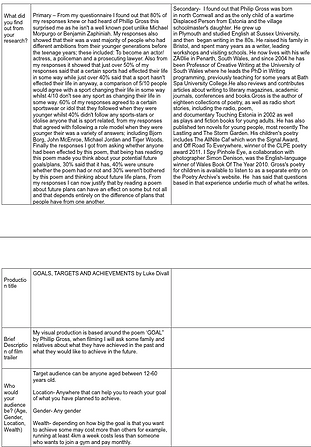
80% of my responses knew or had heard of Phillip Gross this surprised me as he isn't a well known poet unlike Michael Morpurgo or Benjamin Zaphiniah. My responses also showed that their was a vast majority of people who had different ambitions from their younger generations before the teenage years; these included: To become an actor/actress, a policeman and a prosecuting lawyer. Also from my responses it showed that just over 50% of my responses said that a certain sports had effected their life in some way while just over 40% said that a sport hasn't effected their life in anyway, a comparison of 5/10 people would agree with a sport changing their life in some way whilst 4/10 don't see any sport as changing their life in some way. 60% of my responses agreed to a certain sportswear or idol that they followed when they were younger whilst 40% didn't follow any sportstars or idolise anyone that is sport related, from my responses that agreed with following a role model when they were younger their was a variety of answers; including Bjorn Borg, John McEnroe, Michael Jordan and Tiger Woods. Finally the responses I got from asking whether anyone had been effected by this poem, that being has reading this poem made you think about your potential future goals/plans, 30% said that it has, 40% were unsure whether the poem had or not and 30% weren't bothered by this poem and thinking about future life plans, From my responses I can now justify that by reading a poem about future plans can have an effect on some but not all and that depends entirely on the difference of plans that people have from one another.
Secondary Research:
Philip Gross was born in north Cornwall and grew up in Plymouth whilst he studied English at Sussex University. He then began writing in the 1980s. He raised his family in Bristol, and spent many years as a writer, leading workshops and visiting schools. He now lives with his wife Zélie, in Penarth, South Wales, and since 2004 he has been Professor of Creative Writing at the University of South Wales where he leads the PhD in Writing programming, previously teaching for some years at Bath Spa University College.
He also reviews and contributes articles about writing literary magazines, academic journals, conferences and books.
Gross is the author of eighteen collections of poetry, as well as radio short stories, poem, and documentary Touching Estonia in 2002 as well as fiction books for young adults. His earlier poetry books in 1998, The Wasting Game(shortlisted for the Whitbread Prize), and Changes of Address (Bloodaxe 2001). Since then the Bloodaxe book company have published Mappa Mundi (2003), The Egg of Zero (2006), The Water Table (winner of the 2009 TS Eliot Prize),and Love Songs of Carbon (2015), while the poetry and art collaborations have appeared from Cinnamon and Old Stile Press as well.
He has also published ten novels for young people, most recently The Lastling and The Storm Garden. His children's poetry includes The AllNite Café which won the Signal Award, and Off Road To Everywhere, winner of the poetry award 2011. A collaboration with photographer Simon Denison, was the English-language winner of Wales Book Of The Year 2010. Gross's poetry for children is available to listen to as a separate entry on the website. He has said that questions based in that experience doesn't showcase much of what he writes.
In recordings made for the Poetry Archive, Gross's primary subject emerges as the role language plays in the exchanges between the self and the world - from the understated music of 'Severn Song', describing a mercurial landscape where 'two things can be true', to the words withheld, constrained, lost or relinquished that can mask or disclose private suffering in 'Fire Forms' and are powerfully reminded of the variety of ways in which speech and writing can disguise and elevate a range of human situations, through slight modulations of the vowels of animal needs.
Guidline Script:
Storyboards:
Production Schedule:
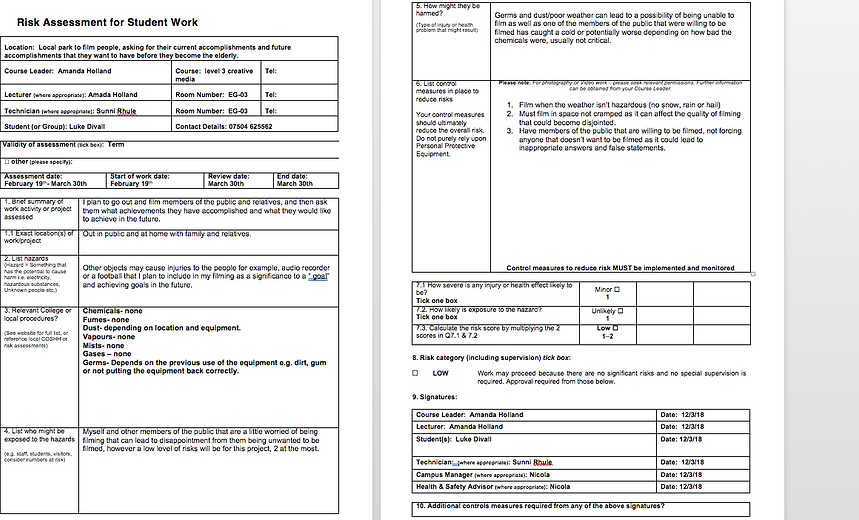
Risk Assessment:
Call List:
Budget:
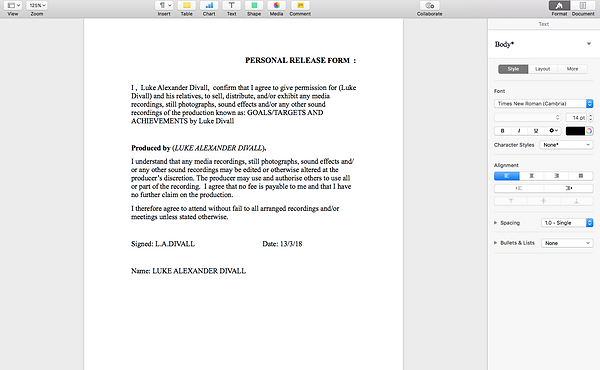
Personal Release form:
Location Permission:
Location Report:
Shooting Script:
Screenshot of my edited production:
MY FINAL VISUAL CREATIVE PRODUCTION:
PEER ASSESSMENT REVIEW:
1. Euan Hirst-Amos;
The feedback I received from Euan was of a mixed variety, he explained that my thought process towards my creative production was very good and that my production could help others that maybe struggled with editing theirs or whether they may have needed help with filming and using a different range of camera angles.
However, he did give me some negative feedback that can be improved upon, this being that my production could've been a little longer than how I presented it and also including more voice-overs from my original chosen script.
2. Harry Elliot;
The feedback I received from Harry featured some positives and some negatives that were fair. He explained to me that my recording/camera angle skills were impressive and that he can benefit from mine as the camera angles he used he happily admitted weren't as good as the ones I used, he also gave me positive feedback from my original plan, storyboards and said that the poem I choose can be relatable to others.
He also did give me some fair negative feedback from my production, this being that, my production could've been recorded better ( the quality wasn't as good as it could have been). Also he said that my production could have been edited a little better maybe with intervals so that the audience could discuss amongst themselves about what they wanted to be when they were younger and also have background music playing whilst people were discussing what their dreams were when they were young.
EVALUATION AND WHY I DECIDED TO CHANGE MY ORIGINAL IDEA:
I decided to change my choice of poem from the 3 that I had originally decided to research that was after i found a poem that i felt i could explain well and have some effect on others depending on whether this film may effect the viewers in some way. My original idea plan was to work in a team with two other close friends who were willing to film with me, however the plans i had were forced to be changed as the people who I thought would help me film could no longer make it in my short film. This then made me change my idea in someway yet also keeping a few things from my first plan, I had to change setting/place of filming and who i filmed it with. I then decided to film in my household living room instead of filming outdoors. Also instead of showing goals and targets by kicking a ball into a goal, I then decided to interview my parents and see what they had to say about their best achievements of their life so far and also anything they want to achieve in the future that people watching could take into consideration and achieve themselves. Considering that I had to change where my filming was originally supposed to take place i think that i did well with the change of my surroundings when filming.
Difficulties: As I mentioned before I had to change where I had planned to film as the people who i planned to film with originally couldn't film on the dates that i needed their help. I then thought that a change of setting may have effected my filming in some way, background noise, audio effects or mainly echoing. However, the setting of filming at home actually benefitted me as there was no audio problems, no background noises and the only possible effect that may have distorted any possible audio was echoing that may have occurred, it actually benefitted me as the audio quality was better when filming indoors rather than outside.
Positives and Negatives to take from my production:
Strengths from my editing are, voiceover recordings prior to me filming, good camera angles when filming the interviews based around my poem and added titles and background music to run through my short film regarding targets/goals and achievements. I had trouble with editing my short film, it could have been longer, thats down to my editing which could be improved. When filming I could have asked to perhaps ellaborate a bit more on their past achievements, perhaps explaining on what made them want to achieve those goals when they were younger, also with future ambitions explaining on how they are going to attempt to reach the target they have set for themselves that they can then look back upon a few years after achieving what they wanted to.
Narrative Theories:
Vladimir Propp- was a russian scholar who analysed Russian folk tales ( fairy tales ) by their narrative structure. Their are 8 types of characters that can be identified from film:
Hero ( protagonist ) has a mission of quest to complete e.g. Luke skywalker
Villian ( antagonist ) tries to stop the hero e.g. Darth Vader.
Princess- love interest and/or object of the quest. ( princess Leia ).
Father- Person of knowledge ( Leia ).
Dispatcher- sends the hero off ( Obi Wan )
Donor- gives the hero something to help him ( Obi Wan ).
Sidekick- the helper ( not as good looking as the hero)- poss. comic relief, C3PO
False Hero- villain that pretends to be good in order to trick the hero.
Roland Barthes- He describes a narrative series of codes that are read and interpreted by the audience.
Action Code ( proairetic code ) - Actions that are significant for the progression of the story. This includes alterations of the state of each narrative for relevant and introduction of a new problem. This can be as simple as a noise or sound.
Tzvetan Todorov
Claude Levi-Strauss
Narrative poems:
Philip Gross: (GOAL)-
One flash and no looking back, that
moment, soundless,
through the plate-glass frontage
of the big-screen (Catch The Big Game
BIGGER!) bar: some
goal! has lifted them clean off their bar stools
and out of themselves,
their mouths wide, like one full-on
gust of wind; there may be words
and, somewhere, losers
(in some mirror-image bar) but here,
now, he's untouchable –
one lad in the dozen, a tad doughy
where his cheap kit top rides up, but hey,
a good half-metre skyward
as if hoisted by his high-flung fists –
Ye-e-es! – launched
like a toddler from a rough grip
under armpits, as if gravity had shrugged
and dad's glasspaper grin
could be always below, great laughter
like God's, without words
in any language, without rights or wrongs
or sides to fall back into. Why else
can we dream of flying,
unless we were made for this?
"The opposite of the octopus's disappearing trick: the poem creates a cloud of ink in order to appear behind it (rather to its own surprise). "
This poem describes a keen and eager young child who has his achievements and life goals prepared ahead of him. The younger generation of kids can look up to as they hope for dreams to become a reality when growing up into adulthood. This poem is categorised under sports and I feel that I can create a short video of dreams becoming a reality. " one flash and no looking back, that moment soundless through the plate/glass of the images from the big screen, ( make the big game BIGGER)". ' go and make a name for yourself and don't look back the world will start to remember you for your accomplishments, " unless we were made for this?
The listeners by Walter de la mere:
A poem/novel on a young man who is trekking the woods at night and looks for a wooden house to stay overnight.
charge of British led by Lord Cardigan against Russian forces during the Battle of Balaclava on 25 October 1854 in the Crimean War. Lord Raglan, overall commander of the British forces, had intended to send the Light Brigade to prevent the Russians from removing captured guns from overrun Turkish positions, a task well-suited to light cavalry.
The events were the subject of Alfred, Lord Tennyson's narrative poem. The Charge of the Light Brigade was published just six weeks after the event. The lines emphasise the cavalry in bravely carrying out their orders, regardless of the obvious outcome. The blame for the miscommunication has remained controversial, as the original order itself and the officer who delivered the orders with some verbal interpretation died in the first minute of the assault. This poem gives an impression of a young boy who has a free and an enjoyable life, he is still young and has many life changing events ahead of him.
The charge of the light brigade:
Charge of British light cavalry led by Lord Cardigan against Russian during the Battle of Balaclava on 25 October 1854 in the Crimean War.
Lord Raglan, overall commander of the British forces, had intended to send the Light Brigade to prevent the Russians from removing captured guns from overrun Turkish positions, a task well-suited to light cavalry.
However, there was miscommunication in the chain of command, and the Light Brigade was instead sent on a frontal assault against a different artillery battery, one well-prepared with excellent fields of defensive fire. They reached the battery under withering direct fire and scattered some of the gunners, but they were forced to retreat immediately. Thus, the assault ended with very high British casualties and no decisive gains. This poem gives an impression of how war changed the landscape and the lives of many amongst us.